Episode Transcript
[00:00:01] When we talk about Black History Month, we often celebrate firsts, milestones, and victories.
[00:00:09] But some of the most important stories are the ones that force us to sit with the truth of what this country has done and what people endure just to stay alive.
[00:00:23] During this month of black history, I am going to share with you some stories about black history in the Hoosier State, about the lives of some extremely important people who helped shape the state of Indiana, how they contributed to our state's history and the impact that we still feel today.
[00:00:45] Who they were as people, the struggles they faced, and most importantly, the achievements that they were able to accomplish during their life.
[00:00:56] My name is Kurt Mullet. I am Hoosier Blue, and I have something to say.
[00:01:03] Let's get at it.
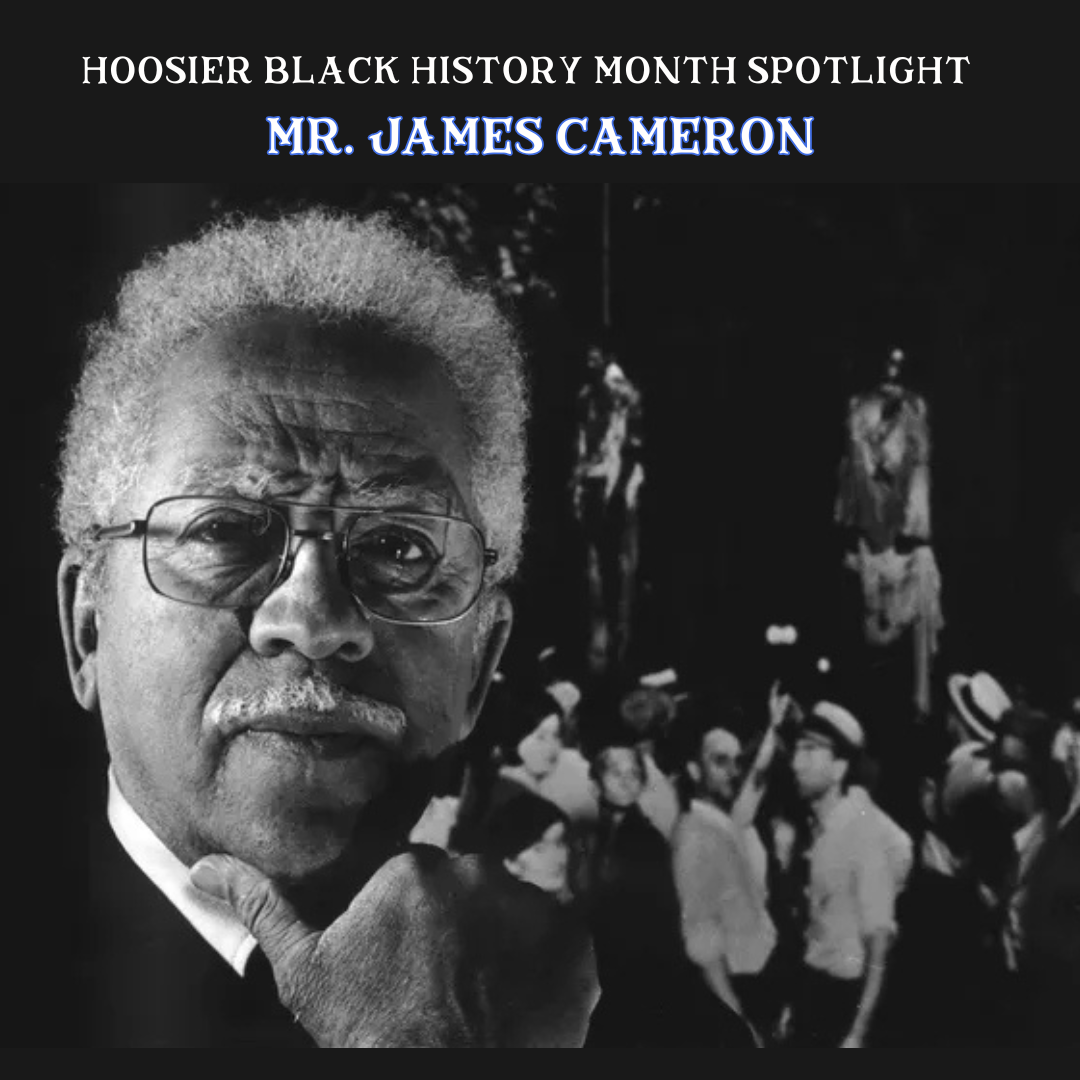
[00:01:11] James Cameron, a man who survived something almost no one survived in America and then spent the rest of his life making sure that all America could not pretend it never happened.
[00:01:26] James was born in 1914 in La Crosse, Wisconsin. His early life didn't come with a sense of stability.
[00:01:35] His family moved again and again from Wisconsin to Alabama and then to Indiana, following jobs, searching for opportunities, trying to build a life that always seemed just a step away.
[00:01:50] And everywhere they went, there was the reality that shaped daily life for black families in America. At the time, segregation wasn't just on paper.
[00:02:03] It was the atmosphere.
[00:02:05] It was warnings and restrictions.
[00:02:08] It was the constant knowledge that the wrong accusation in the wrong place could become a death sentence.
[00:02:19] By the time James was 16 years old, he was living in Marion, Indiana, a small town with deep racial divisions, a community not far from where I live.
[00:02:32] And then came the day of August 7, 1930, a day that would follow him and change him for the rest of his life.
[00:02:44] A white man named Claude Dieter was shot and killed. He was with a woman by the name of Mary Ball, who said she had been assaulted.
[00:02:54] The community reacted with speed and fury, and within hours, police arrested three black teenagers.
[00:03:03] Thomas Shipp, Abram Smith, and James Cameron.
[00:03:09] James would later insist he didn't touch Dieter and didn't harm Mary ball.
[00:03:14] But in 1930, for three black boys in a town on edge, the details didn't carry much weight.
[00:03:23] Rumors spread faster than facts. Anger grew into certainty and a question that should have mattered most.
[00:03:32] What proof do we have?
[00:03:34] Barely seemed to matter at all.
[00:03:37] No evidence was brought forward that clearly tied these young men to the crime.
[00:03:44] But in those days, due process was rarely something black people could count on. And in many ways, that still holds true today.
[00:03:55] As the day turned into night, a crowd of over 10,000 people, including many KKK members from surrounding communities, gathered outside the Grant County Jail.
[00:04:09] Not a handful of people. A mob. The kind of mob that arrived believing it had the right to become judge, jury and executioner.
[00:04:21] That night, James Cameron was beaten so badly he was nearly unconscious. A noose was placed around his neck. He was dragged out and taken under the same tree where his Thomas Shipp and Abram Smith were being lynched.
[00:04:38] James later wrote about what it felt like in that moment, about sensing his life slipping away, as if his soul were already leaving his body.
[00:04:51] He was 16. 16 years old, standing beneath a tree that had become a public stage for racial terror.
[00:05:05] But then something happened that still feels almost impossible to say out loud.
[00:05:12] A voice cut through the chaos.
[00:05:15] A woman's voice.
[00:05:17] Someone in the crowd shouted that James was innocent.
[00:05:22] People hesitated.
[00:05:23] The mob paused.
[00:05:26] And in a moment that defied the pattern of that era, they did not kill him.
[00:05:34] They let him go.
[00:05:36] James, who was severely bruised and bleeding, was drugged back to his jail cell alive.
[00:05:44] It's hard to even imagine what that kind of survival does to a person, because surviving didn't mean he was free.
[00:05:54] It didn't mean justice suddenly arrived.
[00:05:58] It just meant he wasn't dead.
[00:06:02] The lynching made national news and produced one of the most infamous, horrifying photos of a lynching that has ever been published.
[00:06:15] Afterwards, James would spend the next four years in prison.
[00:06:20] He was convicted as an accessory before the fact, even with a lack of evidence, even though Mary Ball was unable to identify him or any of the other boys.
[00:06:36] This was a racially motivated, illegal lynching of two teenagers whose lives were taken and James, whose life was also nearly taken based on accusation, mob violence and racial discrimination.
[00:06:52] Not one person from the mob was charged with a crime.
[00:06:57] Not one.
[00:06:59] So what happened after that?
[00:07:01] What do you do after you've seen a crowd decide you deserve to die.
[00:07:07] And only a sudden shift in the moment keeps you alive.
[00:07:11] James Cameron chose a path that turned survival into purpose.
[00:07:19] After his release, he became a civil rights organizer. He founded four NAACP chapters in Indiana. He served as Indiana's state director of the Office of Civil Liberties. He fought segregation in the places where it shows up in everyday life. Housing, policing and public spaces.
[00:07:43] He spoke and lectured across the country, telling the story that many people would rather forget because forgetting is comfortable for those who didn't have to live it.
[00:07:56] In the 1950s, he moved to Milwaukee, Wisconsin, where he became known as a community leader, someone whose experience wasn't just personal history, but a kind of moral guidepost.
[00:08:09] He understood Something that's easy to miss. When we treat racial violence like old news, if we don't preserve the memory, the harm doesn't disappear.
[00:08:20] It just changes shape. It falls into silence. And silence can be its own kind of permission.
[00:08:29] That belief led him to create something extraordinary on Juneteenth. In 1988, James founded America's Black Holocaust Museum in Milwaukee.
[00:08:42] The museum was built with a clear mission.
[00:08:46] To document the history of slavery, racial violence, and the long struggle for civil rights.
[00:08:54] To preserve the memory of the victims of racial terror and to educate the generations who came after so they would understand what happened and why it still matters.
[00:09:10] The museum became one of his most enduring legacies, not just because it held history, but because it confronted people with asked visitors to stop treating violence as an abstract idea and to recognize it as a lived reality that shaped families, communities, and the country itself.
[00:09:35] In 1993, the state of Indiana pardoned Mr. James Cameron.
[00:09:41] It was a formal acknowledgment that was long overdue, but yet significant, that what happened to him in the legal system was wrong.
[00:09:55] Still, no pardon can give back the years that were taken from him, and no pardon can restore the lives that were stolen on that night. In Marion, Indiana, Mr. James Cameron lived to be 92 years old.
[00:10:12] He died in 2006, decades after the night he was supposed to die.
[00:10:20] And before he passed, he wrote an autobiography called A Time of Terror, making sure his history and the broader story of racial violence in America could not be erased or softened into something easier to hear.
[00:10:39] When you step back and look at his life, it's hard not to feel the weight of what it represents.
[00:10:46] Mr. Cameron was a witness and a victim to the very worst of what America could be.
[00:10:53] Yet he chose to spend his life pushing America to be something better.
[00:10:59] His story reminds us that history isn't distant.
[00:11:03] It is sealed away in textbooks. It breathes, it echoes. It shapes what we accept, what we tolerate, and what we're willing to confront.
[00:11:17] And sometimes history leaves us a witness, someone who survives the impossible so that the rest of us don't get to look away.
[00:11:30] And that someone in this story is Mr. James Cameron.
[00:11:39] I want to thank you for your support. You can find my video podcast on YouTube and on Substack. Just search for Hoosier Blue 63. I appreciate your support.
[00:11:51] Drop me a comment or a like.
[00:11:53] I love to converse and have conversations with people about the topics that I discuss and share with you.
[00:12:00] My name is Kurt Mullet.
[00:12:03] I'm Hoosier Blue and I have something to say.
[00:12:08] Catch you on the flip side.